

BMW Diesel Engines N47 and N57 were installed in hundreds of thousands of vehicles in the 1, 3, 5, and 7 Series, as well as the X1, X3, X5, and X6, between the mid-2000s and 2015–2016. Renowned for their driving pleasure, smoothness, and fuel efficiency, they have also inherited a more controversial reputation: that of engines which, after a certain mileage, reveal recurring design flaws.
If you own a BMW equipped with one of these engines, understanding these weak points is more than just a matter of technical curiosity. It’s what allows you to anticipate a breakdown, avoid unexpected downtime, and make the right choices when it’s time for maintenance. That is the whole point of this article.
Why do the N47 and N57 engines have this reputation?
The N47 (primarily a 4-cylinder, 2.0L engine) and the N57 (6-cylinder, 3.0L engine) share a similar architecture and components, which explains why they often suffer from the same issues. Three main categories of problems are most frequently reported by owners and specialized repair shops:
- Retail Chains with Poor Location
- The EGR cooler that develops internal cracks
- The plastic coolant outlet that cracks
Each of these weaknesses deserves to be explained in detail, as they do not all manifest in the same way and do not all have the same level of severity.
1. The distribution chain: a known design flaw
On the first generations of the N47, BMW positioned the timing chain at the rear of the engine, against the transmission, rather than at the front as is more commonly the case. This design makes replacement particularly costly, as it requires removing the engine.
The problem stems not only from the chain's position, but from its very design: some batches have shown premature stretching—sometimes as early as 100,000 to 130,000 km—with a risk of breakage that could result in complete engine failure if the chain breaks while the vehicle is in motion.
Warning signs: A metallic noise at idle, a rattling sound when the engine is cold, and the check engine light is on with codes related to timing misalignment.
2. The EGR cooler: an internal crack that is difficult to detect
The EGR (exhaust gas recirculation) system includes a cooler designed to lower the temperature of the exhaust gases before they are recirculated into the intake. On the N47 and N57 engines, this cooler is known to crack from the inside, causing the coolant to mix with the exhaust gases.
In practical terms, this results in a loss of coolant without any visible leaks outside the engine, white smoke from the exhaust, and sometimes abnormal pressure in the cooling system during startup.
This is an insidious problem because it is often mistaken for other leaks in the cooling system, particularly the one we're about to discuss in detail.
3. Coolant Leak from a Plastic Component: The Most Common Problem
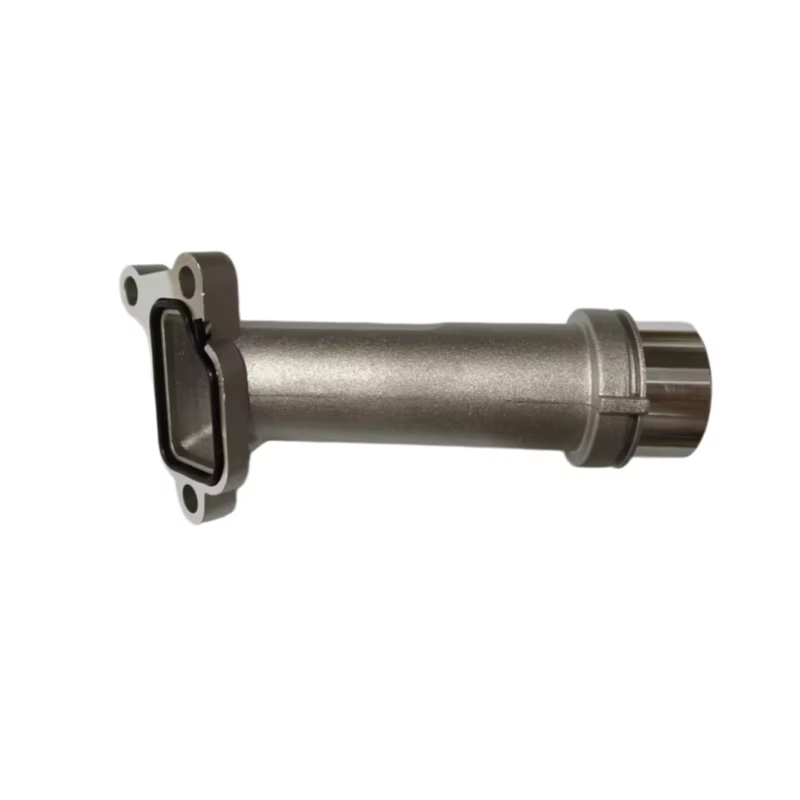
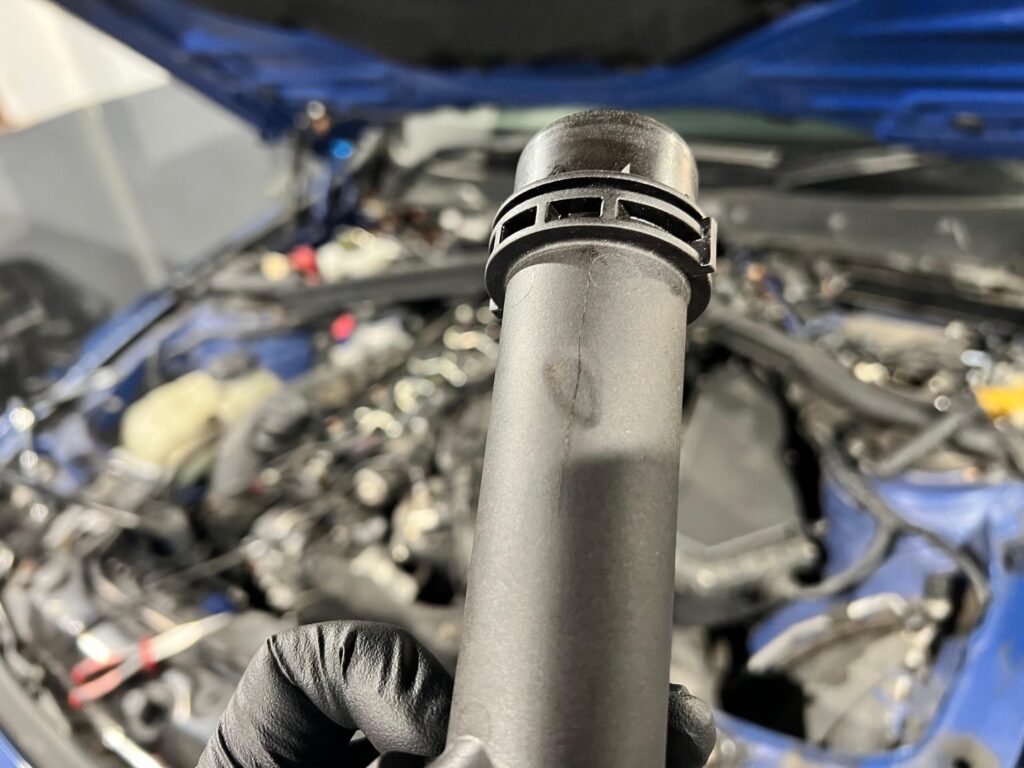
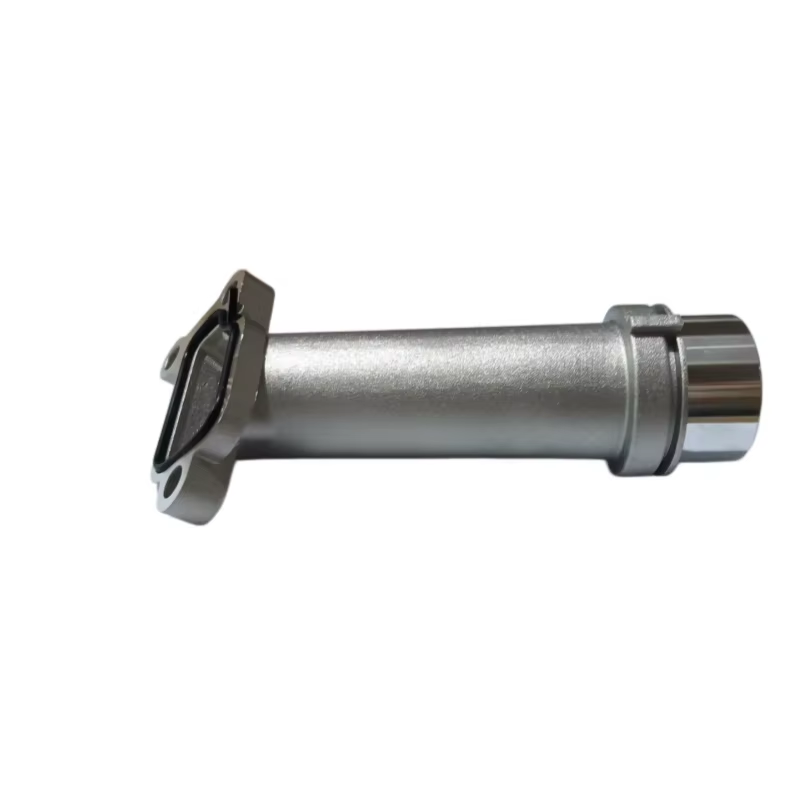
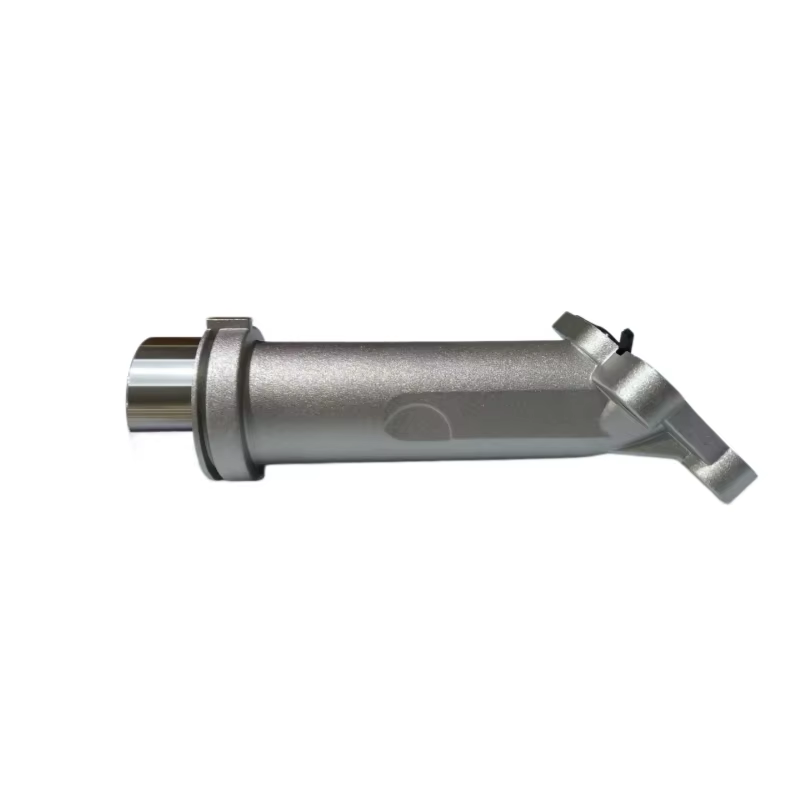
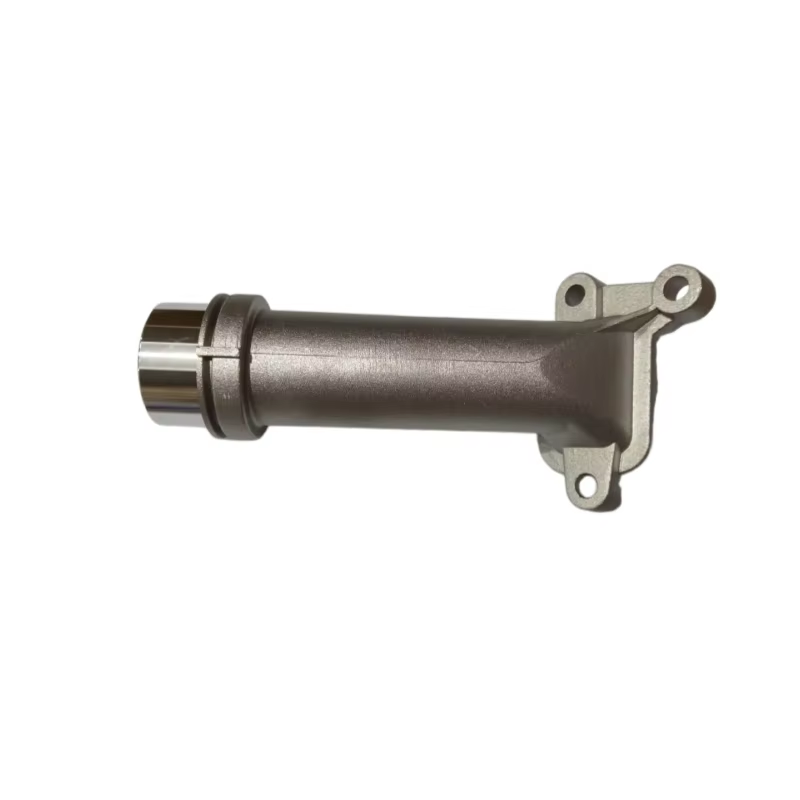
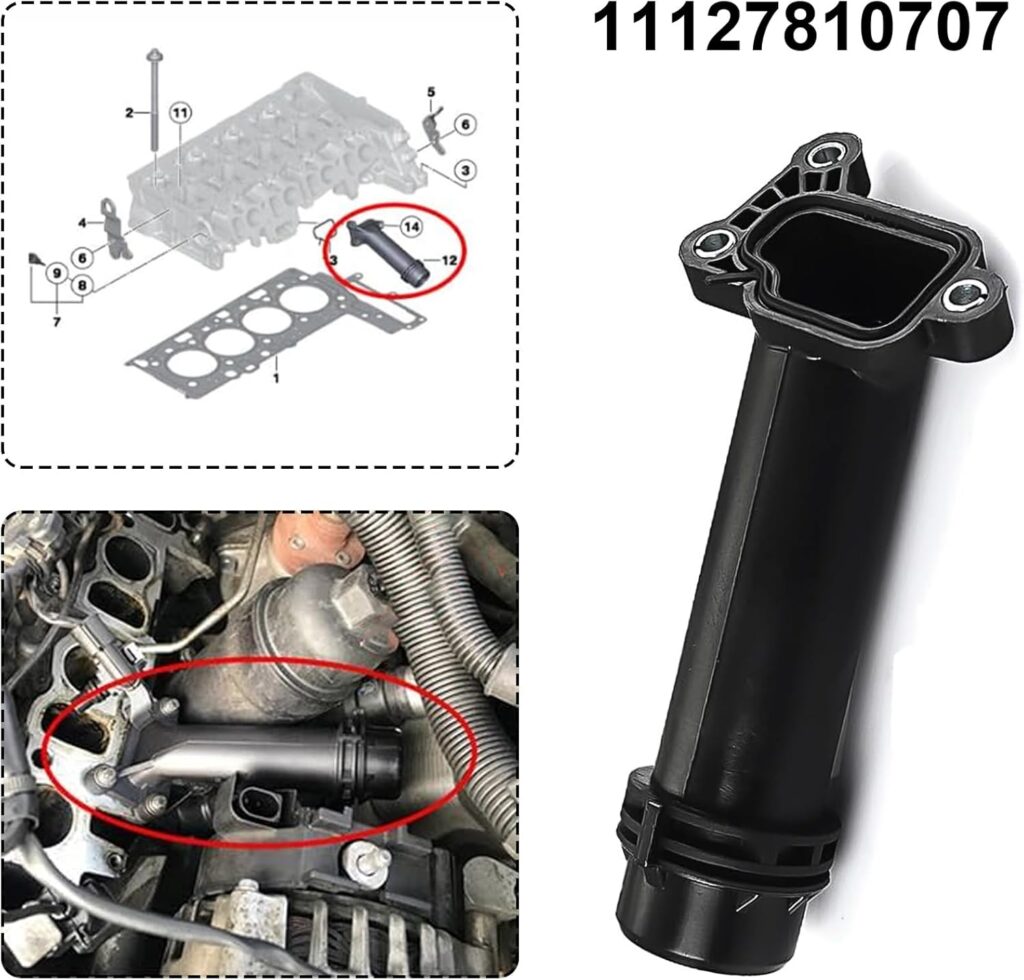
This is where we get to the heart of the matter. On virtually all N47 and N57 engines, BMW chose to manufacture the coolant outlet fitting at the cylinder head outlet plastic. This part, often called a «bride» or «coolant pipe» in French, and in English coolant pipe, coolant flange or coolant outlet, has the manufacturer's part number 11127810707.
What is this room used for?
It is fitted directly into the cylinder head and connects the hot coolant outlet to the rest of the system (hoses, water pump, thermostat, radiator). It is sealed by an O-ring.
Why does this part break all the time?
Unlike the distribution chain or the EGR cooler, whose failures vary by production batch, the vulnerability of this part is almost systematic Over time, for one simple reason: its location.
Mounted directly on the cylinder head, it is constantly exposed to:
- temperatures that may exceed 100 °C when in contact with the coolant,
- repeated heating and cooling cycles during each run,
- the continuous vibrations from the engine block,
- the pressure in the cooling system.
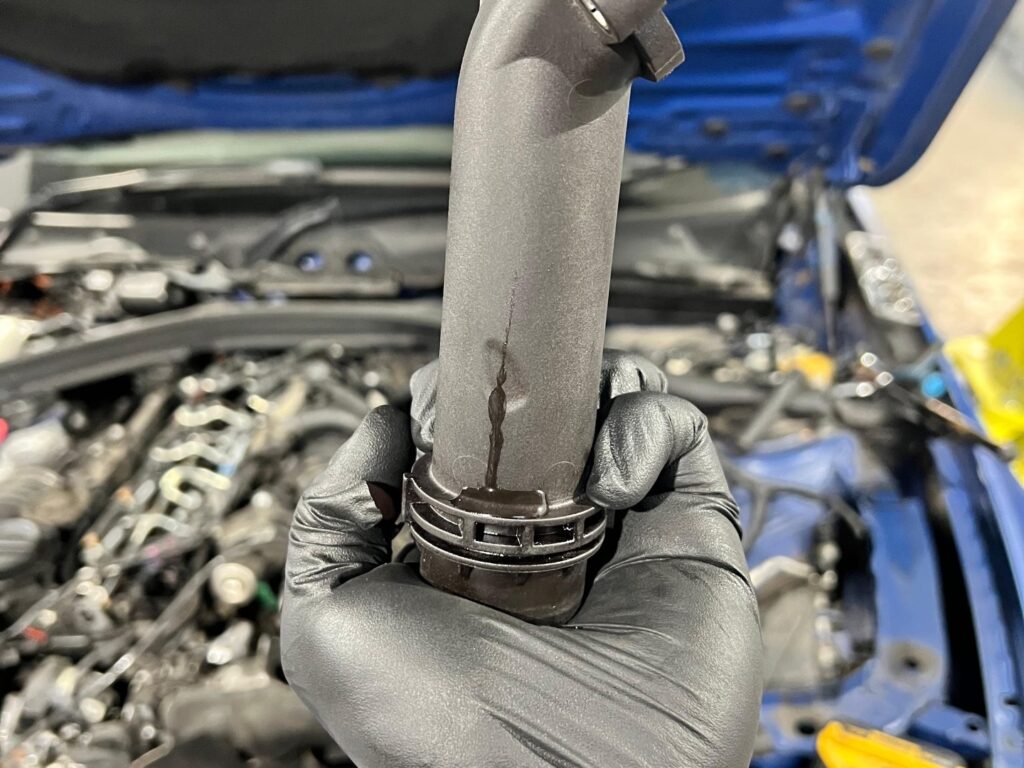
Plastic, no matter how durable it may be when new, gradually loses its elasticity due to the combined effects of heat and time. It becomes brittle. A crack eventually appears, most often along the length of the tube, at the point most exposed to heat.
This is a scenario that is very common among 120,000 and 250,000 km, but which may occur sooner in vehicles subjected to repeated short trips or heavy use.
How can you tell if this problem has occurred?
The symptoms most frequently reported by owners are:
- a steady, unexplained drop in the coolant level,
- a «Add Coolant» warning message on the dashboard,
- a smell of hot liquid after a drive,
- dried white or pinkish streaks around the intake manifold,
- drops of liquid under the vehicle,
- A leak located at the rear of the engine that is difficult to spot visually.
The problem is that this part is located in a hard-to-reach area, often hidden by the intake manifold. Many owners drive for several weeks, topping off the coolant, before realizing the exact source of the leak, which poses a real risk of engine overheating if the leak suddenly gets worse.
Why use a plastic part on an engine that's under such heavy strain?
It’s fair to wonder why a manufacturer like BMW made this choice. The answer can be summed up in two words: cost and weight. Injection-molded plastic is cheaper to produce in large quantities than a machined or cast aluminum part, and it offers a slight weight reduction. On paper, this choice makes sense during the design phase. In reality, after several years of actual use, it has become one of the most well-documented weaknesses of these engines, to the point that it is widely discussed on technical forums and among BMW diesel specialists.
The solution: replace plastic with aluminum
In light of this, a solution has gradually gained acceptance among professionals and enthusiasts: replacing the original plastic part with a version machined from aluminum, designed to exactly match the original dimensions, assembly, and O-ring.
That is exactly the philosophy of our Reinforced Aluminum Coolant Hose for BMW N47/N57, which matches the original BMW assembly exactly in every dimension (replaced part number: 11127810707) without requiring any modifications.
How Aluminum Makes a Real Difference
| Criterion | Genuine plastic part | Aluminum version |
|---|---|---|
| Heat Resistance | Becomes more fragile over time | Consistent over time |
| Vibration Resistance | Known vulnerability | Significantly superior |
| Long-term waterproofing | Deteriorates as cracks form | Preserved through precision machining |
| Estimated service life | Often 120,000 to 250,000 km | Far superior |
| Assembly | Same | Identical (plug-and-play) |
This isn't about modifying your BMW, but about eliminating a known design flaw while strictly maintaining the original appearance, installation, and compatibility. At Macote, we call this an approach OEM+ : preserve the vehicle's core identity while addressing its documented weaknesses.
Why replace this part as a preventive measure?
Many car owners discover this part… just when it’s already leaking. However, replacing it as a preventive measure is truly worthwhile, particularly because accessing it requires partially disassembling the engine (often the intake manifold). This disassembly is already performed during certain routine maintenance procedures:
- replacement or cleaning of the intake manifold,
- work on the cooler or the EGR valve,
- replacement of glow plugs,
- Work on the intake flaps (swirl flaps).
Taking advantage of one of these disassemblies to replace this part with an aluminum version as a preventive measure can help you avoid paying for the same labor twice a few months or years later.
In a nutshell
The N47 and N57 engines are good BMW diesel engines, but they are not without known design flaws, of which the plastic coolant outlet is one of the most common and easiest to fix permanently. Understanding this weakness, knowing how to recognize its symptoms, and planning ahead to replace the plastic part with an aluminum solution can help you avoid a costly breakdown and unnecessary downtime.
Check out our Reinforced Aluminum Coolant Hose – BMW N47/N57 in our store, designed to permanently replace BMW part number 11127810707.
 Français
 English
 Español