
It’s one of the best-selling aftermarket parts, and one of the most misunderstood. People attribute miraculous properties to it on forums, it appears in every photo of a modified engine bay, and yet many drivers who install one don’t dare admit that they didn’t notice any difference.
So I might as well say it right away: The anti-roll bar does have a real effect, but its effectiveness depends heavily on the car it's installed on. On some cars, the difference is noticeable right from the first turn. On others (especially recent BMWs), it’s close to zero.
This article explains why, so you'll know which situation applies to you.
What an anti-collision bar actually does
The problem she is trying to solve
In a modern car, there is no separate chassis: the body itself serves as the structural framework. This is what is known as a self-supporting hull (or monocoque). The front suspension is attached to it at two high points, the shock absorber mounts, located on either side of the engine compartment.
When you take a turn, the outer wheel is subjected to considerable stress. This stress is transmitted through the shock absorber to the top of the strut. And the strut, which is nothing more than a piece of stamped sheet metal, bends very slightly : a few tenths of a millimeter, but enough for the suspension geometry to deform under load.
The result: the wheel’s actual camber is no longer exactly what you set it to, and the front-end response becomes slightly less precise—a bit «softer»—during weight transfer.
The Solution
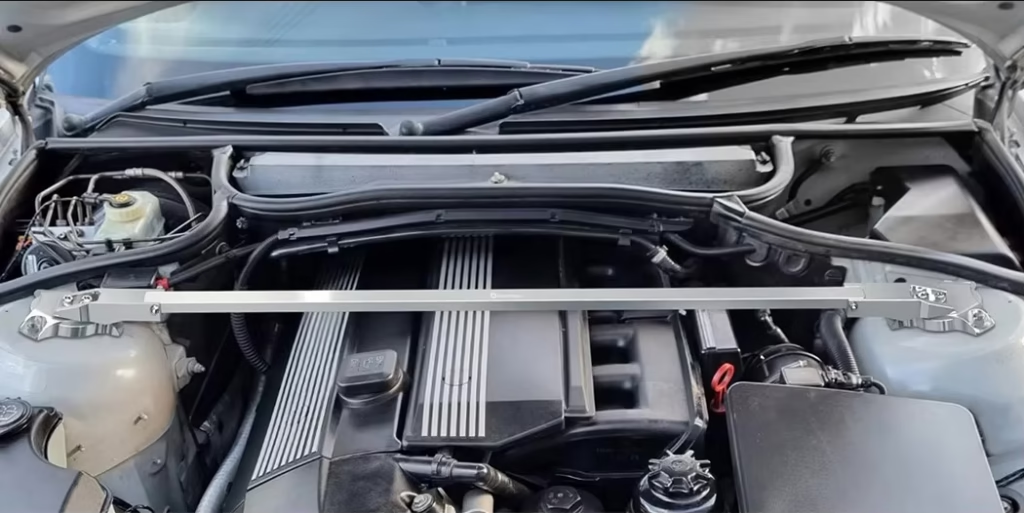
The bar connects the two shock absorber towers at the top. It transforms two independent points—each moving on its own—into a triangulated structure : Whatever one wants to do, the other stops her from doing it.
In practice, this reduces the relative movement between the two towers. The suspension operates within a more stable geometry, and the front end responds more immediately and predictably.
That's also where the name comes from: it prevents tricks from to get closer from one another under duress. The Germans refer to Domstrebe (dome spacer), the English from strut brace or strut tower bar.
Not all reinforcements are the same
The term «anti-rapprochement bar» is often used to refer to any type of engine bay reinforcement. This is a shorthand term, and it is misleading.
The top crossbar
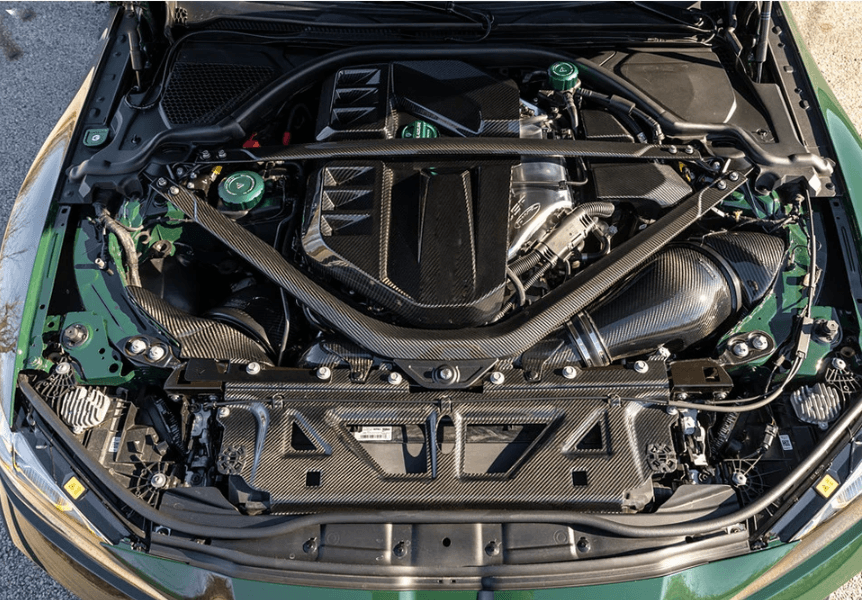
This is the anti-collision bar in the strict sense: a single piece, which runs through the engine compartment from one tower to the other. This is the one shown in the photos—the most prominent and the best-selling model.
Diagonal bracing (or struts)
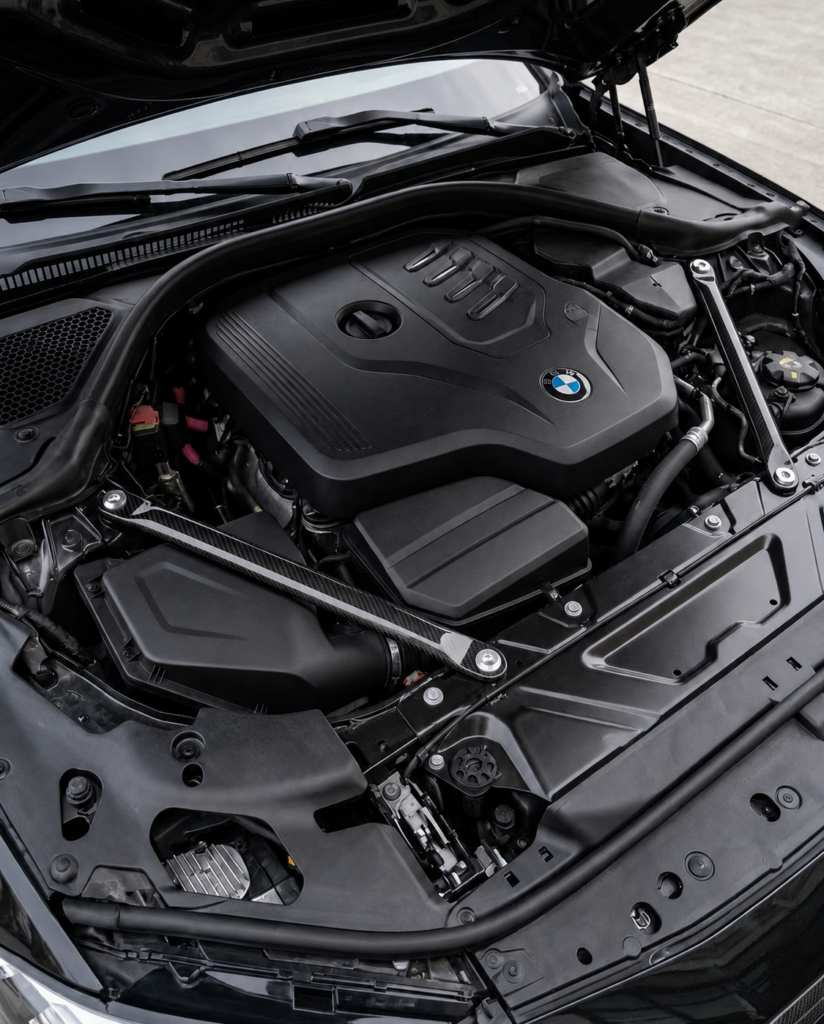
Two separate rooms, one on each side, connecting the shock absorber tower area to the vehicle's front structure: crossmember, side member, or radiator mount.
They do not operate in the same plane as the crossbar: while the crossbar resists lateral movement, the diagonals resist longitudinal movement—the kind that occurs during braking and compression.
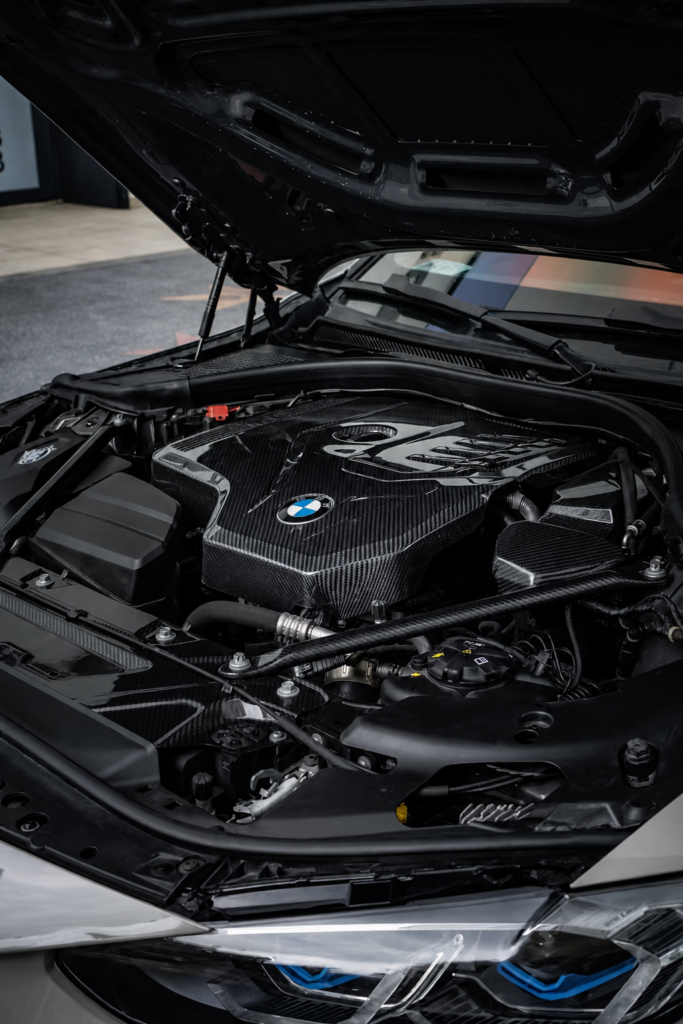
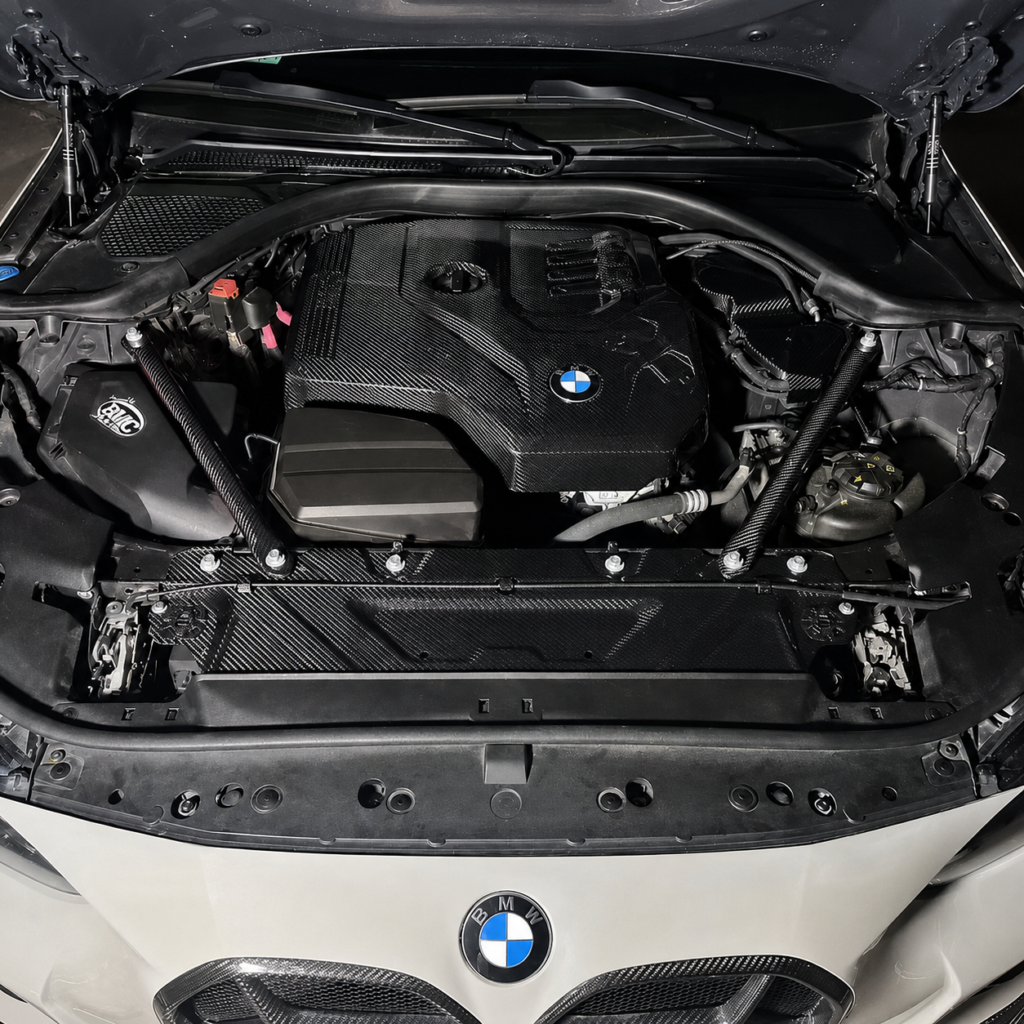
This is the type of reinforcement that BMW installs as standard on the G20, G22, and G42 models. Many homeowners refer to them as “anti-approach bars” out of habit, which is understandable, but technically they are something else.
The bottom bar
Mounted under the engine, between the lowest points of the suspension. Less dramatic since it’s hidden from view, but often more effective: the lower part of the body is subjected to greater structural stress than the upper part.
The rear bar
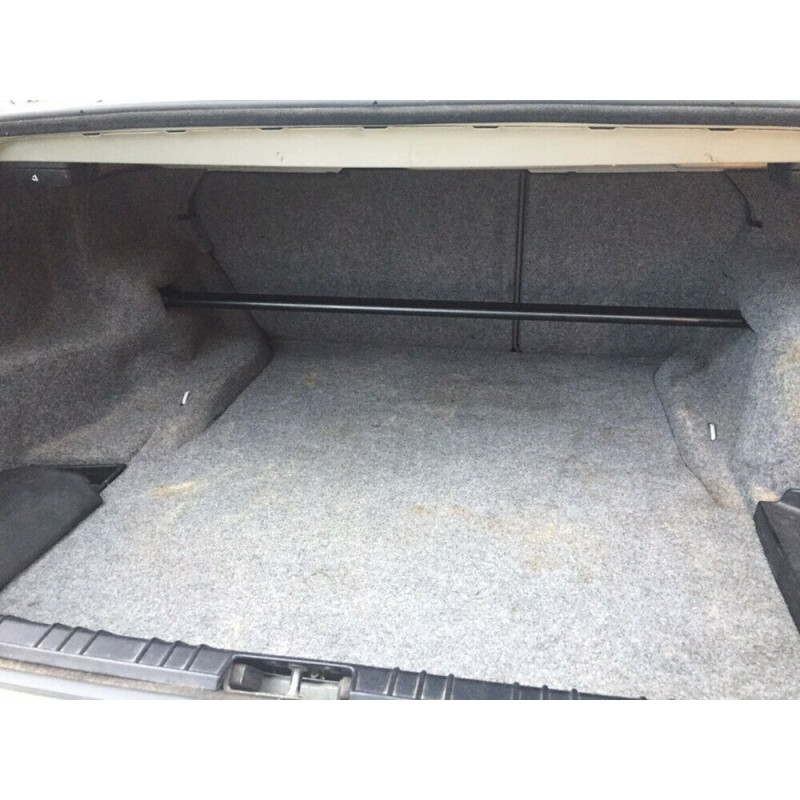
The same principle applies to the rear shock absorber struts. In a sedan, it often runs through the trunk. Its usefulness depends largely on the car’s design.
Does it really work?
That's the question you're interested in, and the honest answer is: It depends on how stiff your car already is.
A strut does not create stiffness out of thin air. It complements an existing structure. If that structure is already very stiff, there isn't much to be gained.
Cases where the effect is clear
Convertibles and open-top cars. This is the most obvious example. Removing the roof eliminates a major part of the structure. Torsional stiffness can drop by half compared to the equivalent coupe. Any reinforcement added makes a difference.
Classic cars. A car body from the 1980s or 1990s is significantly less rigid than a modern one, both because of its design and because 200,000 km of potholes have worn down the welds.
Highly modified cars. If you’ve installed short springs, coil-over kits, stiff rubber bushings, and semi-slick tires, you’re subjecting the body to stresses that the manufacturer didn’t anticipate. The body then becomes the weak link, so reinforcing it makes sense.
Track uses. On the track, cornering is prolonged, repeated, and pushed to the limit. That’s when minor deformations become noticeable.
Cases where the effect is marginal
A modern, unmodified car used on public roads. Today's chassis use steels with very high yield strengths and structures optimized through computational analysis. They are already extremely torsionally rigid. Adding a strut provides a real but slight improvement that few drivers can honestly claim to feel on open roads.
This is exactly the case with the BMW G20, G22, and G42. The CLAR platform boasts stiffness levels that engineers in the 1990s could never have imagined, and BMW has already incorporated the reinforcements it deemed necessary. There is little room for improvement.
One point that few sellers mention
A bar only works on its own level. A top strut effectively prevents the towers from moving closer together, but does almost nothing to counteract the overall twisting of the body—the kind where the front left side rises while the front right side drops. That’s why serious tuners think in terms of a coherent set of reinforcements, not individual parts.
And there's a downside that's rarely mentioned: a steeper slope filter less. You gain in precision, lose a little in comfort, and hear more road noise. In a car meant for daily commuting, that’s not always a good trade-off.
The Special Case of Modern BMWs
If you drive a G20, G22, or G42, your situation is different from the one described in most articles on the subject, which discuss base models.
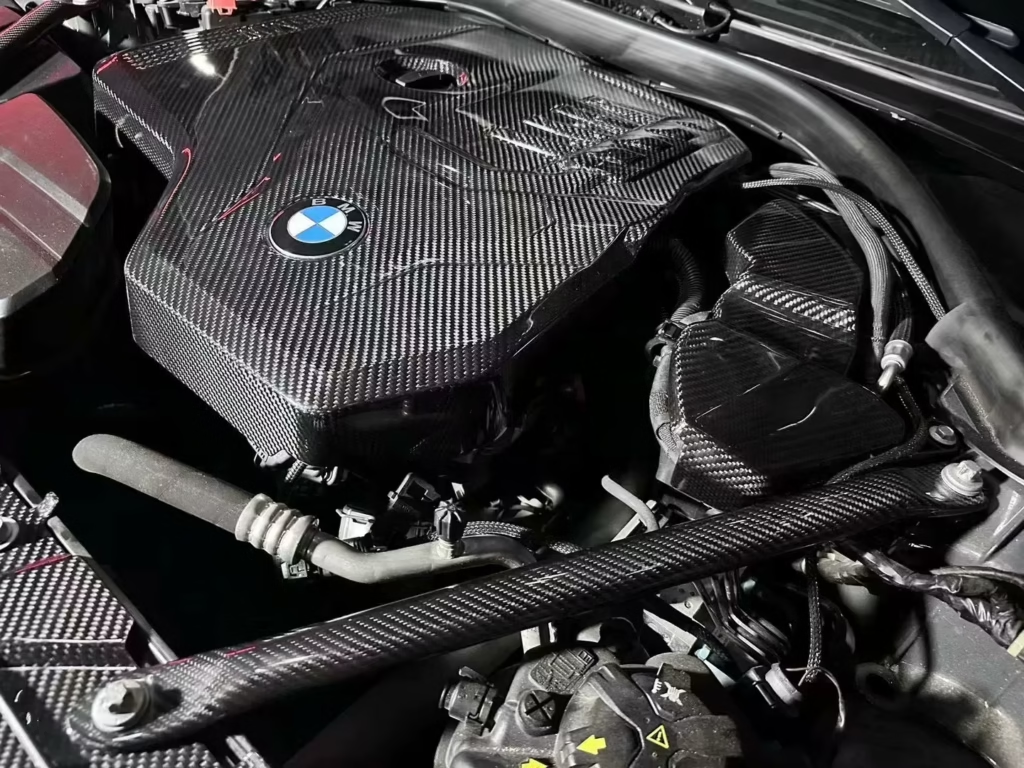
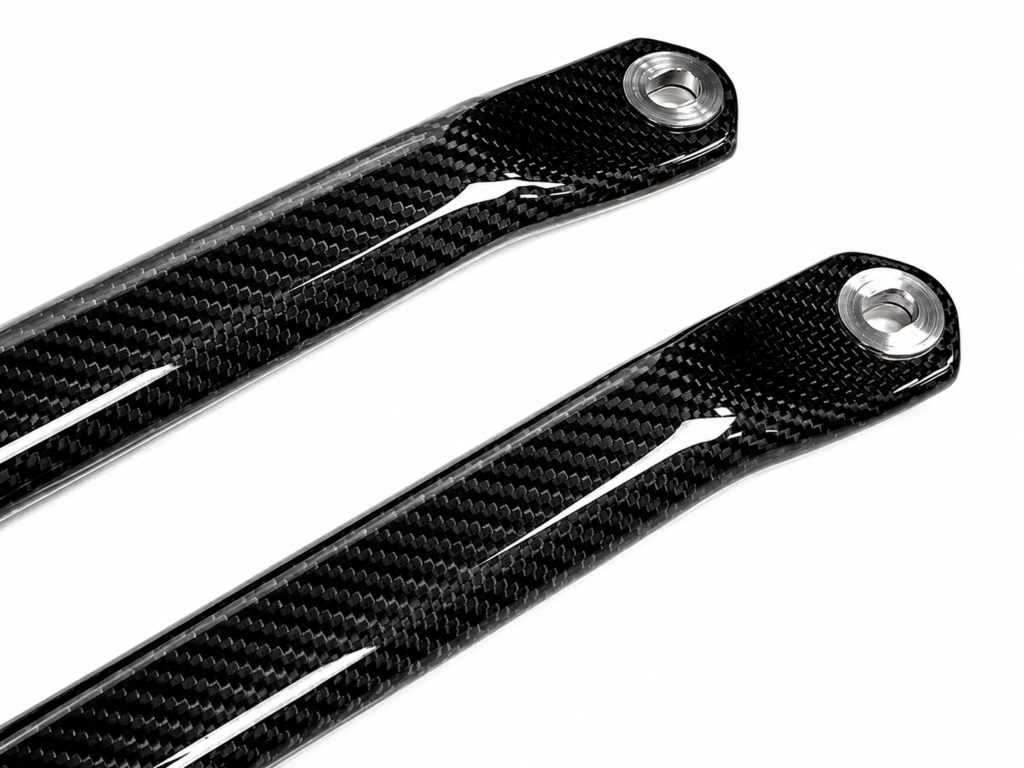
Your car is already equipped. Open the hood: you'll see two diagonal bars, one on each side, extending forward from the shock absorber mount area. They're made of aluminum, and BMW has sized them specifically for your platform.
That completely changes the question. You're not asking yourself «Should we add a reinforcement?» — The manufacturer has already responded. You're wondering «What can I do with this room?»
And the honest answer, in the vast majority of cases, is aesthetics.
The argument that people rarely dare to make
We're going to be straightforward, because that's what we'd like to hear from others.
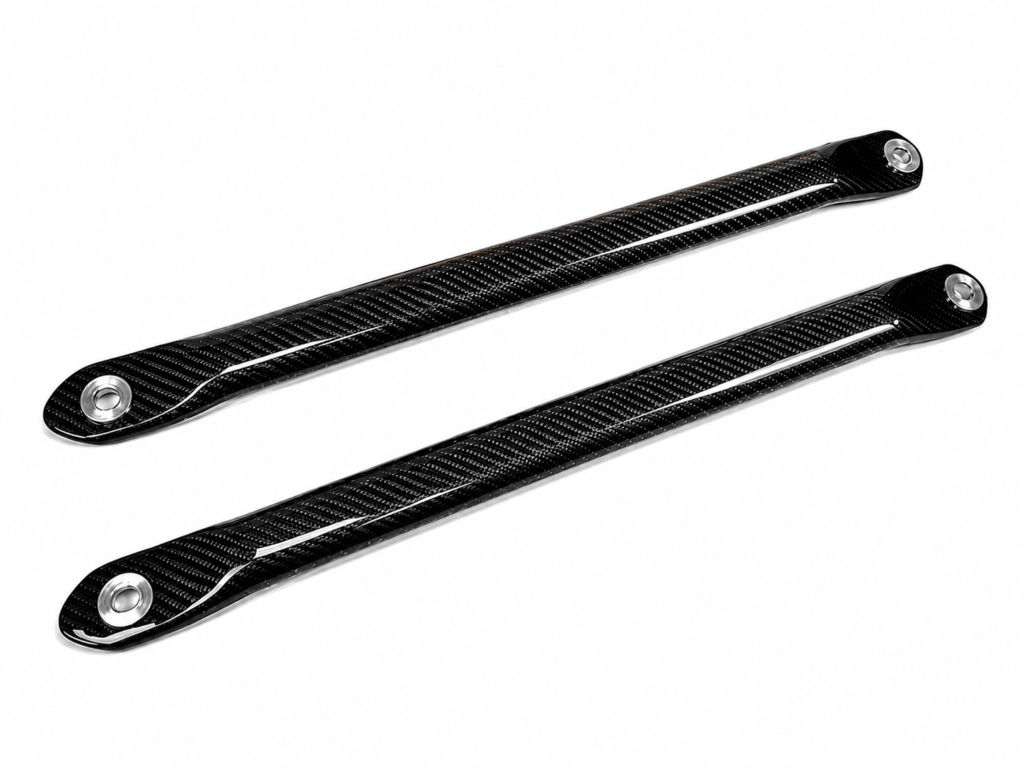
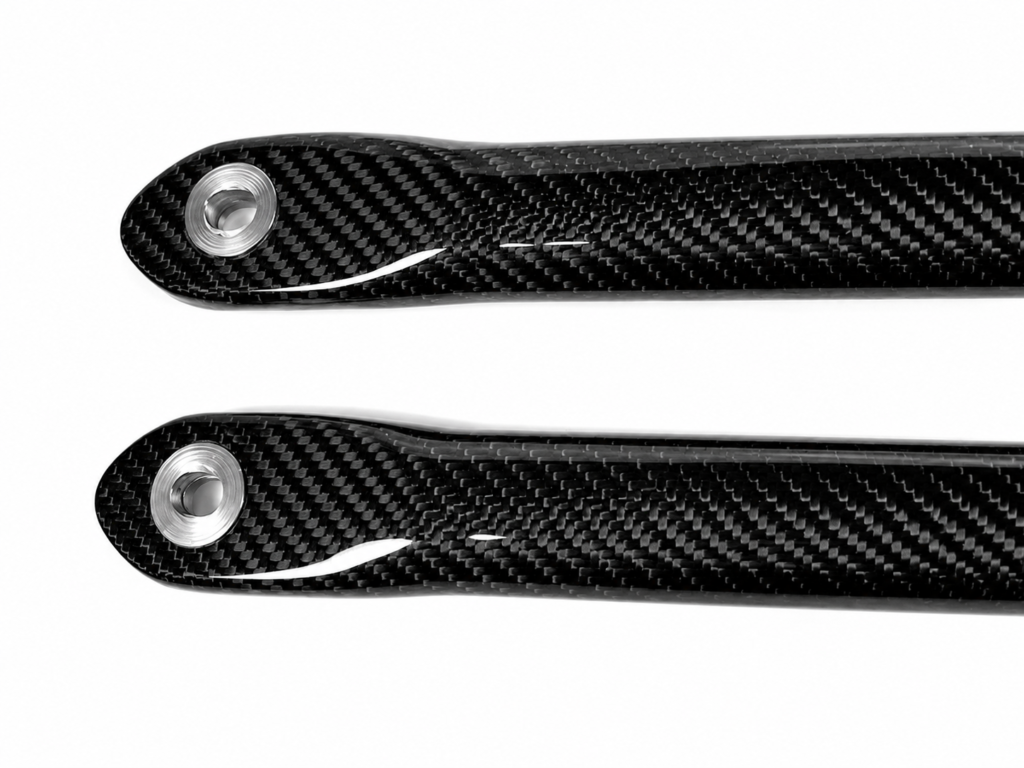
On a stock modern BMW, replacing an aluminum brace with a carbon-fiber brace won't change your handling. Anyone who tells you otherwise is pulling the wool over your eyes.
On the other hand, it transforms the one part of your car that you always show off and that has remained completely stock.
And that has real value. The engine bay of a recent BMW features matte black plastic and raw aluminum. Every year, automakers hide more of it. What remains visible (those two bars, specifically) is what sets a run-of-the-mill engine bay apart from a well-finished one.
No one installs forged rims just for the unsprung weight. No one buys an Alcantara interior for its mechanical properties. Aesthetics is a perfectly legitimate reason to modify your car. It just deserves to be acknowledged as such.
How to Choose, in Practice
| Your Situation | What Makes Sense |
|---|---|
| Genuine modern BMW, for road use | A purely aesthetic part; no performance gains to be expected |
| Convertible | A Truly Useful Reinforcement |
| Classic car or high-mileage car | A useful reinforcement, to be used in conjunction with an inspection of the weld points |
| Modified suspension, high-performance tires | Reinforcement consistent with the rest |
| Regular circuit use | A useful addition, but we need to look at the big picture |
Two safety guidelines, no matter what your situation may be:
Choose pieces that use the original mounting points. A reinforcement that requires drilling into the body creates initial cracks and may alter the structure's behavior in the event of a collision. The manufacturer has designed zones of controlled deformation.
And Be wary of promises backed by numbers without supporting data. «+30 % in stiffness» on a product sheet, without a test protocol or test bench, means nothing.
Frequently Asked Questions
Is an anti-collision bar approved?
A part that is mounted on existing mounting points, without modifying the body, will not pose a problem during the vehicle inspection. A part that requires drilling or cutting is a different matter and makes you liable.
Front or back—where should I start?
At the front in almost all cases: that is where steering and braking efforts are concentrated.
Does it damage the car?
No, as long as the part is properly designed and mounted at its original mounting points. The risk arises only with poorly fitted parts, which create permanent stress where none existed before.
Is it necessary to realign the suspension after installation?
This isn't necessary for a part that is an exact replacement for an original component. It may be justified if you're adding a reinforcement where there wasn't one before and the car is already finely tuned.
Aluminum, steel, or carbon: What's the difference?
Steel is the stiffest material for a given cross-sectional area, but it is also the heaviest. Aluminum offers a good balance, which is why manufacturers choose it. Carbon fiber has the best stiffness-to-weight ratio. along the grain, but its performance depends entirely on the quality of its construction: the number of folds, the orientation, and the baking method. A well-made carbon is excellent; a poorly made one is merely a decorative item. That’s why the supplier is so important.
In a nutshell
The anti-sag bar is neither a miracle solution nor a gimmick. It is a practical technical solution to a specific problem (the deformation of shock absorber mounts), and its effectiveness depends entirely on your car’s initial condition.
Whether it’s a convertible, a classic car, or a heavily modified vehicle, it fits right in. On a stock BMW G20, G22, or G42, the manufacturer has already done the work, so the real focus becomes the appearance.
That’s a perfectly valid reason—as long as you’re willing to own up to it.
Do you drive a recent 2 Series, 3 Series, or 4 Series? Check out our carbon fiber engine bay reinforcement bars, designed to replace the original reinforcements without drilling or modification.
 Français
 English
 Español